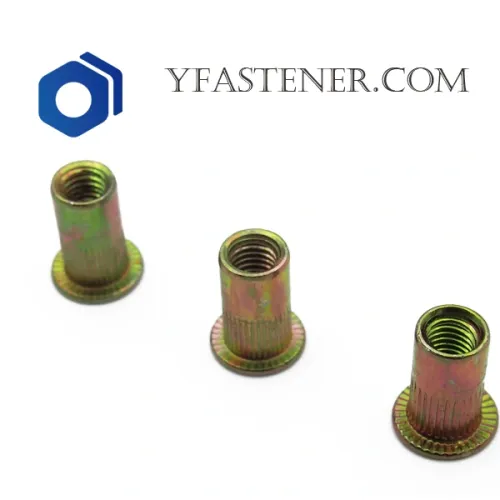
| Standard | DIN 7337, ISO 15973 |
| Size | M4, M5, M6, M8, M10 |
| Surface Treatment | YZP |
Product Introduction
Standard Name: Rivet Nut or Nutsert (Expansion Rivet Nut).
Common Names: Rivet Nut, Expansion Cap, Expansion Rivet Nut.
Product Definition: A single-sided installation blind hole fastener. Using a specialized riveting gun, the core shaft is pulled to expand the sleeve's tail end, forming a permanent, high-strength, internally threaded insert in sheet metal, tubing, or profiles. This solves the challenge of creating reliable threaded connection points in materials where access from the reverse side is impossible.
Rivet Nut YZP Key Features
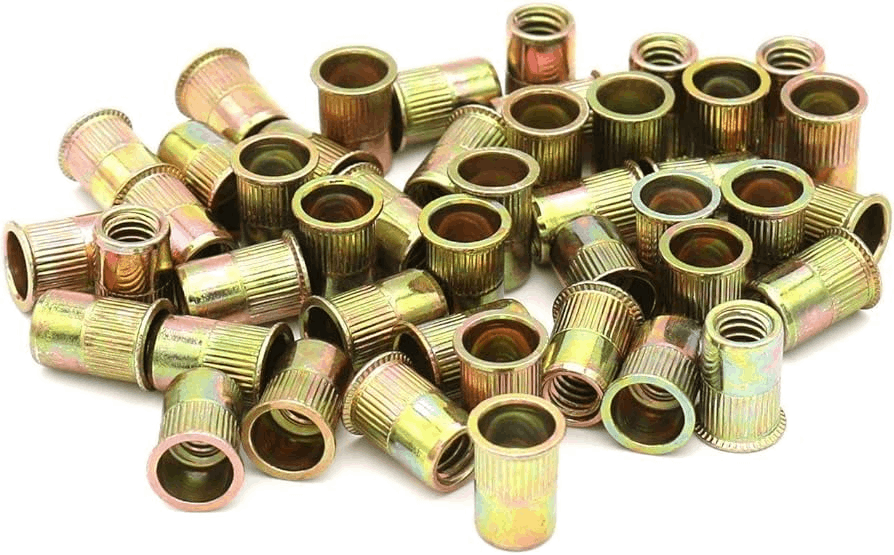
Yellow Zinc Plated (YZP): Passivated with yellow chromate, providing moderate corrosion protection
(superior to white zinc). The surface is golden yellow, aesthetically pleasing, and wear-resistant,
suitable for indoor or slightly humid environments.
Deformation Fixing Design: Cylindrical body with a closed internal thread at one end. Deformation
during installation creates a secure threaded hole, suitable for thin plates or single-sided operation.
Material and Types: Commonly made of carbon steel. Head options include flat, countersunk, or small
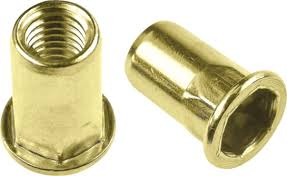
head; body options include smooth, knurled, or semi-hexagonal for enhanced grip.
Various Specifications: Diameter M3-M12, gripping range 0.5-6mm, conforming to DIN or ISO standards.
Advantages: Blind hole installation, economical and aesthetically pleasing, high strength, but not
suitable for extreme corrosion.
Working Principle Rivet Nut YZP
Insertion into the Hole: Insert the nut into the pre-drilled hole, with the head conforming to the
material surface.
Riveting Deformation: Using a rivet gun or tool, the bolt is pulled, causing the cylinder to compress and
expand, securing it to the back of the material to form a flange.
Thread Formation: Deformation provides a permanent internal thread for bolt tightening; a yellow zinc
plating protects against corrosion.
Load Distribution: The expanded portion evenly distributes force, resisting pull-out; the principle
involves plastic deformation and frictional grip.
Product Applications
Automotive Manufacturing: Secures body panels, bumpers, or interior trim, providing lightweight
connections.
Home Appliances and Electronics: Assembles housings, brackets, or circuit boards; convenient
single-sided mounting.
Sheet Metal Processing: Creates threaded holes in thin metal sheets, tubing, or profiles.
Furniture and DIY: Assembles metal frames or equipment; aesthetically pleasing and practical.
Industrial Equipment: Secures light machinery or ventilation ducts; the yellow finish enhances its
appearance.