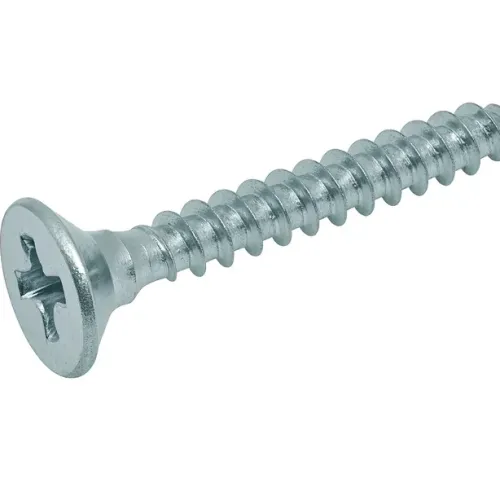
| Standard | DIN EN ISO 7050 |
| Grade | A2-70 (304) , A4-80 (316) |
| Surface Treatment | Passivation |
Product Introduction
Standard Name: Countersunk (Flat) Head Tapping Screw, Stainless Steel.
Common Names: Stainless Steel Countersunk Self-Tapping Screw, Stainless Steel Flat Head Self-Tapping Screw, 304 Stainless Steel Self-Tapping Screw.
Product Definition: A self-tapping screw featuring a 90° (or 82°) countersunk head, manufactured from stainless steel (typically SS304/A2). It eliminates the need for pre-tapped holes by directly forming threads in softer materials, resulting in a flush-mounted head after installation. Its stainless steel composition delivers superior rust resistance, corrosion resistance, and a clean appearance.
Self-Tapping Screw Flat Head (SS) Key Features
Flat Head Design: The head has a tapered flat top (typically 82° or 100° angle), flush with the surface
after installation, providing a smooth appearance and even pressure distribution.
Stainless Steel (SS): Commonly AISI 304 or 316 grade, offering excellent corrosion resistance, oxidation
resistance, and hygiene, suitable for humid, acidic, alkaline, or food-grade environments.
Self-Tapping Thread: Sharp tip, thread design that cuts through the material to form an internal thread,
eliminating the need for pre-tapping.
Drive Type: Commonly Phillips or slotted, for easy actuation.
Advantages: Flat and aesthetically pleasing, highly corrosion-resistant, easy to install, but with moderate
strength.
Working Principle
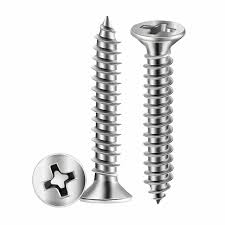
Self-Tapping Entry: The tip penetrates the material, cutting a matching internal thread.
Head Insertion: The flat head gradually sinks into the countersink, generating an axial clamping force.
Load Distribution: The tapered head distributes pressure evenly, preventing surface bulges; the stainless
steel passivation layer provides long-term corrosion protection.
Installation Control: Precise depth control using a screwdriver avoids excessive depth damage to the
material; the principle involves material cutting and friction interlocking.
Product Applications
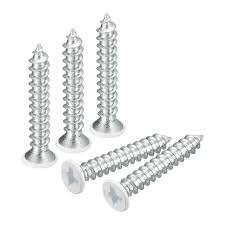
Electronics & Electrical: Secures panels, housings, or circuit boards, providing a smooth surface.
Medical & Food: Assembles equipment or containers, hygienic and corrosion-resistant.
Marine & Chemical: Connects components, resisting humid or acidic/alkaline environments.
Automotive & Aerospace: Interior trim or lightweight mounting; flush design enhances safety.
DIY & Repair: Thin-film connections in everyday projects, ensuring long-term reliability.