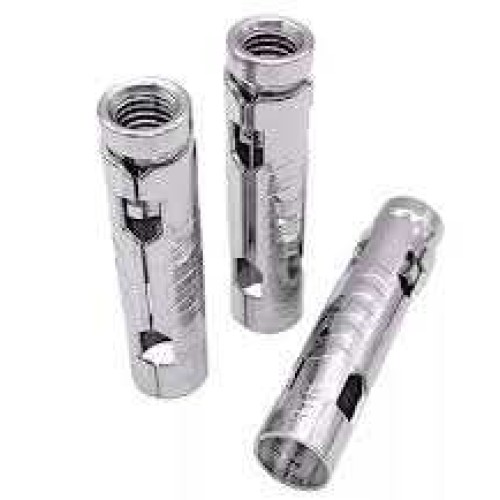
| Standard | ISO 3506 |
| Grade | A2-70 (304) , A4-80 (316) |
| Surface Treatment | Passivated |
Product Introduction
Standard Name: Tam Shield Anchor (Stainless Steel).
Other Names: Stainless Steel Shield Anchor, Stainless Steel Fish Scale Anchor, Stainless Steel Three/Four-Piece Expansion Anchor Bolt.
Product Definition: A heavy-duty, multi-piece (typically three- or four-piece) mechanical expansion anchor bolt specifically designed for critical load-bearing fixings in concrete. It utilizes hammering to uniformly expand the internal stainless steel expansion sleeves (“fish scales”) within the drilled hole, forming powerful mechanical interlocking keys. This provides exceptionally high tensile and shear load-bearing capacity alongside outstanding corrosion resistance.
Tam Anchor SS Key Features
Stainless Steel (SS): Commonly AISI 304 or 316 grade, providing excellent corrosion resistance, oxidation
resistance, and hygiene, suitable for humid, acidic, alkaline, or salt spray environments.
Inflatable Shield Design: Composed of a tapered nut, inflatable shield body, and bolts, it expands evenly,
providing high grip and pull-out resistance.
Strength and Durability: High-strength design suitable for medium to heavy-duty fixing on solid substrates
such as concrete and masonry; natural surface finish, no additional coating required.
Various Sizes: Diameter M6-M20, length 50-200mm, supports projected or loose types.
Advantages: Strong grip, removable, durable, hygienic, long-term reliability, but more expensive than
carbon steel versions.
Working Principle
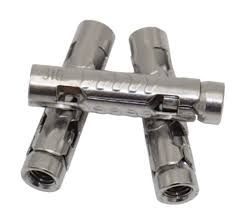
Drilling Installation: Drill holes of matching diameter and depth in the substrate and insert the anchor bolt.
Expansion Process: When the bolts are tightened, the conical nut is pulled into the shield, causing the
shield to expand outwards and grip the borehole wall tightly.
Load Distribution: The expansion force is evenly distributed, providing balanced high gripping force;
the stainless steel passivation layer resists chemical corrosion.
Fixing and Removal: Strong clamping force is generated, allowing for removal by loosening the bolts;
the principle involves mechanical expansion and frictional gripping.
Product Applications
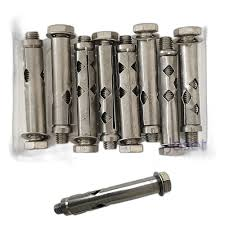
Marine and Shipbuilding: Fixing equipment or structures, resisting seawater corrosion.
Food and Pharmaceutical: Installing processing equipment or containers, hygienic and pollution-free.
Chemical Industry: Fastening pipes or valves, resistant to acid and alkali environments.
Construction and Outdoor: Bridge railings, curtain walls, or outdoor fixing, providing long-term stability.
Medical and Cleanrooms: Assembling instruments or supports, non-magnetic and corrosion-resistant.