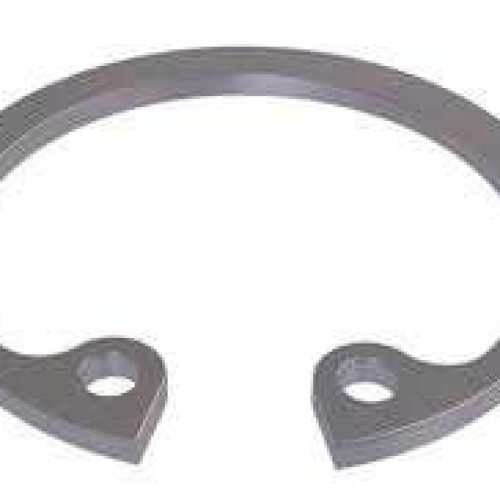
| Standard | DIN 471, BS 3673-4:1977 |
| Surface Treatment | KP, ZP, PL |
Product Introduction
Standard Name: Spring Circlip / Retaining Ring.
Common Names: Spring Retaining Ring, Elastic Retaining Ring, Snap Ring, Open Spring Ring.
Product Definition: An elastic retaining ring with an opening, manufactured from spring steel. Installed in the groove of a shaft or bore, it utilizes the radial force generated by its elastic deformation to restrict axial movement of components within the shaft or bore. It is a widely used axial positioning fastener.
Key Features of Spring Circlip
Flexible Opening Design: C-shaped or spiral opening structure with high flexibility, facilitating
installation/removal using specialized pliers. It snaps into the groove of the shaft or hole for axial
positioning.
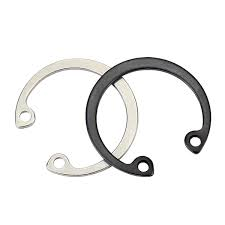
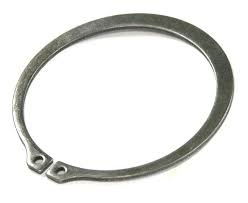
Various Types: External (on the shaft), Internal (in the hole), E-clip (lightweight), Spiral ring
(earless design).
Material and Strength: Commonly made of spring steel or stainless steel, fatigue-resistant and
vibration-resistant; surface can be phosphated, zinc-plated, or have a natural stainless steel luster,
providing corrosion resistance.
Various Specifications: Diameter 3mm-400mm, thickness 0.4mm-10mm, conforming to DIN 471/472,
ISO 8752, and other standards.
Advantages: Threadless, quick installation, reusable, space-saving, economical and reliable.
Working Principle
Groove Installation: Use circlip pliers to compress the opening and insert it into the groove of the
shaft/hole.
Elastic Recovery: Upon release, the ring elastically recovers its diameter, tightly locking into the groove
and providing axial support.
Positioning and Fixing: Prevents axial movement of components; the open design facilitates disassembly.
Load Distribution: Distributes axial force evenly and resists vibration; the principle involves elastic
deformation and mechanical interlocking.
Product Applications
Mechanical Transmissions: Fixes bearings, gears, or pulleys on shafts to prevent axial movement.
Automotive Industry: Assembles transmissions, engines, or suspension components.
Household Appliances: Positions rotors in washing machines, motors, or pumps.
Precision Instruments: Machine tools, robots, or optical equipment; commonly found in lightweight
E-type applications.
Industrial Equipment: Universal shaft/hole fixing, saving assembly space.