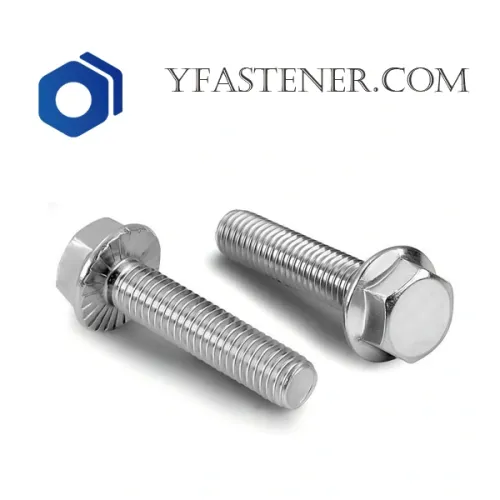
| Standard | DIN 6921, ISO 1665 |
| Grade | 8.8, 10.9 |
| Surface Treatment | HDG, YZP, BO |
A flange bolt (also called a hex flange bolt or frame bolt) is a type of fastener with a hexagonal head and an integrated circular flange directly under the head. This built-in flange acts like a washer, distributing load over a larger area and often eliminating the need for a separate washer.
Standards: Common in DIN 6921 (metric), EN 1665, or SAE/IFI for imperial (e.g., IFI-111 for hex flange screws).
Flange Bolt Key Features
Integrated Flange Design: A large flange (similar to a gasket) is built into the head, evenly distributing
the load, preventing bolt embedment in the material surface, and improving connection stability.
Hexagonal Head: Facilitates torque application using wrenches or socket tools, ensuring efficient
installation and removal.
Materials and Coatings: Typically made of carbon steel, stainless steel, or alloy steel, with ZP finishes
available for rust protection, suitable for moderately corrosive environments; flanges can be smooth or serrated for enhanced anti-loosening properties.
Strength and Specifications: Strength grades such as 4.8, 8.8, or 10.9, diameters M5-M30, various lengths,
conforming to standards such as DIN 6921 and ISO 7380.
Advantages: Eliminates the need for separate gaskets, saves assembly time, is economical and practical,
and suitable for vibrating environments.
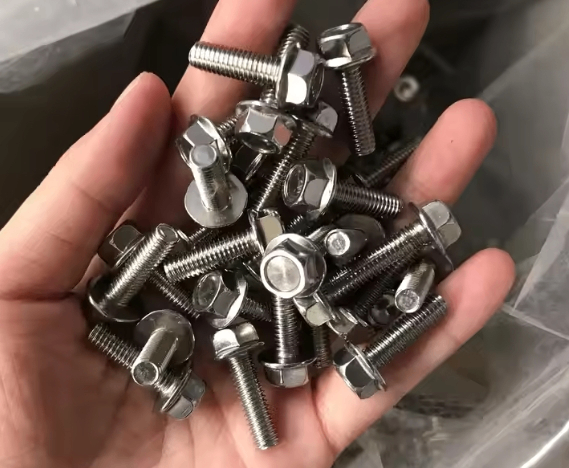
Working Principle
Threaded Fit: The external thread of the bolt matches the internal thread of the nut or pre-drilled hole,generating axial tensile force through rotation.
Clamping Force Generation: When torque is applied, the bolts stretch, creating a clamping force. Theflange expands the contact area, evenly distributing pressure and preventing material deformation or
loosening.
Anti-Loosening and Load Distribution: The serrated flange increases friction, resisting loosening caused
by vibration; the zinc plating protects the threads from corrosion, ensuring long-term performance.
Mechanical Balance: Under load, the flange provides a larger bearing surface, reducing stress
concentration. This principle involves the control of the coefficient of friction and elastic deformation.
Overall, it achieves a secure fixation through mechanical interlocking and surface support, making itparticularly suitable for applications requiring high stability.
Product Applications
Automotive Industry: Secures vehicle frames, engine mounts, or suspension systems; the flange design
resists vibration, improving safety.
Machinery Manufacturing: Assembles heavy equipment such as machine tools, pumps, valves, or
conveyors, providing a stable connection.
Civil Engineering: Connects steel structures, flange fittings, or bridge components, evenly distributing
forces to enhance durability.
Piping and Plumbing: Secures flange joints, such as water pipes or gas systems, preventing leaks.
Industrial and DIY: Used for appliance housings, furniture assembly, or warehouse shelving, as a
cost-effective standard fastener.