| Standard | ISO 4161/10663, DIN 6923, ASTM A563 |
| Grade | 4.8,8.8, 10.9 |
| Surface Treatment | ZP, YZP, HDG,PL |
Product Introduction
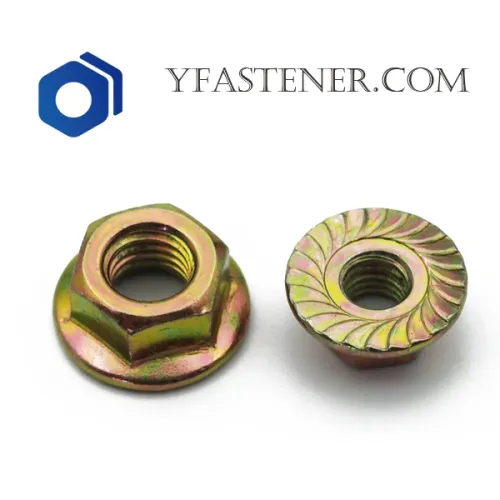
Standard Name: Hexagon Nut with Flange or Flange Nut.
Common Names: Washer Nut, Hex Flange Nut, Serrated Nut.
Product Definition: A hex nut featuring a wide flange (washer) at one end. Its core design integrates nut and washer functions, effectively distributing pressure through an enlarged contact surface to prevent surface crushing of connected components and provide superior anti-loosening performance in vibrating environments.
Hex Flange Nut Key Features
Integrated Flange Design: Built-in wide flange (smooth or serrated) at the bottom evenly distributes
the load, eliminates the need for a separate gasket, improves connection stability, and enhances
anti-loosening performance.
Hexagonal Shape: Standard hexagonal shape for easy tightening with wrenches or socket tools,
ensuring efficient installation.
Materials and Coatings: Commonly made of carbon steel, stainless steel, or alloy steel, with finishes
including zinc plating (ZP), hot-dip galvanizing (HDG), or blackening, providing different levels of
corrosion resistance; strength grades such as Grade 5, 8, or A2-70.
Diverse Sizes: Diameters M5-M36, supporting standard or heavy-duty flanges, conforming to standards
such as DIN 6923 and ISO 4161.
Advantages: Saves assembly time, vibration-resistant and anti-loosening, economical and practical;
the serrated design is particularly suitable for vibrating environments.
Working Principle
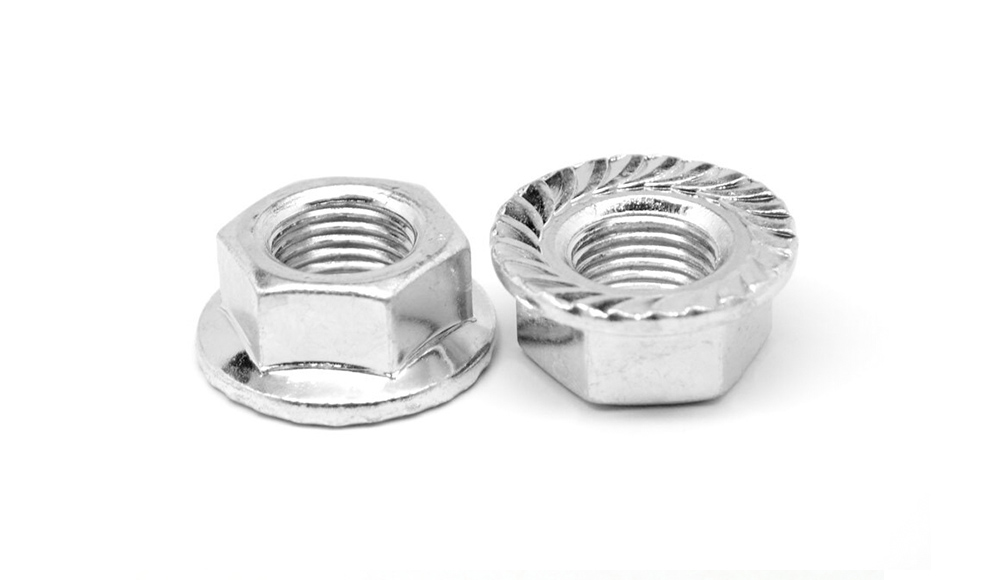
Threaded Fit — The internal thread matches the bolt, generating axial clamping force through rotation.
Load Distribution — The flange increases the contact area, evenly distributing pressure and preventing
material deformation; the serrated flange's embedded surface increases friction, resisting loosening.
Anti-Loosening Mechanism — The flange provides mechanical locking, maintaining preload under
vibration; the principle involves increased friction coefficient and elastic deformation.
Installation Control — When torque is applied, the flange ensures stability, preventing overtightening
and damage to the connection surface.
Product Applications
Automotive Industry — Secures engine, chassis, or suspension components, resisting vibration and
simplifying assembly.
Machinery Manufacturing — Assembles equipment, pumps, valves, or conveyors, providing a
stable connection.
Civil Engineering — Connects steel structures or pipe flanges, evenly distributing force.
Electronics and Electrical Appliances — Secures housings or brackets, saving space.
Industrial Equipment — Used in heavy machinery or production lines, cost-effectively as a
standard accessory.