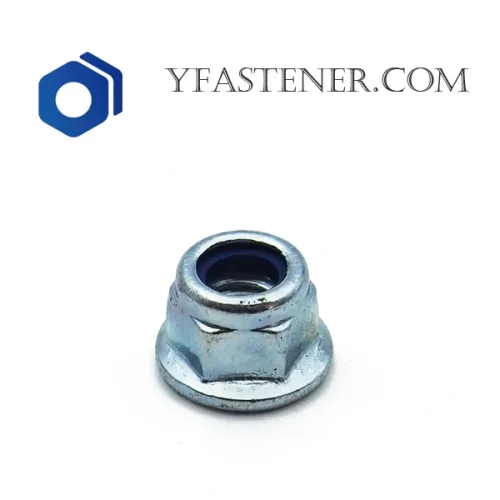
| Standard | EN 1663, DIN 6926, ISO 7043 |
| Surface Treatment | ZP, HDP, PL |
Product Introduction
Standard Name: Self-Locking Hexagon Nut with Flange (ISO 7043, DIN 6927, and other series standards)
Common Names: Anti-loosening flange nut, flanged self-locking nut, self-locking washer integrated nut
Product Definition: The self-locking flanged hex nut is an integrated fastener combining a flanged base (equivalent to an internal washer) with self-locking functionality. It achieves reliable anti-loosening in mechanical vibration environments by generating sustained friction through embedded nylon rings in the threaded section or crown (or via fully metallic deformation threads). The flanged base expands the pressure-bearing area, protects connection surfaces, and enhances preload.
Key Features
Highly Effective Anti-Loosening: Built-in nylon locking rings or all-metal deformation threads generate lasting friction after tightening, effectively resisting loosening caused by vibration and dynamic loads.
Integrated Design: Flange and nut are molded as a single unit, eliminating the need for additional washers. This simplifies inventory, prevents missing parts, and speeds up installation.
Superior Load-bearing and Compression Resistance: The wide flange base distributes load pressure, reducing damage to connected surfaces. Ideal for soft materials or applications requiring high clamping force.
High Reusability: Premium nylon rings or precision metal deformation designs allow multiple disassembly and retightening cycles (typically 5-10+ reuses) without significant loss of locking performance.
Superior Sealing and Insulation: The nylon ring provides effective sealing against liquid ingress while offering electrical insulation properties.
Working Principle
The self-locking function of the nut primarily relies on its non-metallic insert at the top (typically a nylon ring) or a fully metallic thread deformation structure. When the nut is screwed onto the bolt:
Nylon ring type: The inner diameter of the nylon ring is slightly smaller than the mean diameter of the bolt thread. During engagement, the nylon is compressed and deformed, generating strong radial restoring force that tightly grips the bolt threads. This creates lasting frictional resistance, preventing loosening.
• All-Metal Deformation Type: Precision plastic deformation (e.g., ovalization, slotting) at the thread tip or mid-section creates an interference fit between the modified threads and the bolt threads. This utilizes metal elasticity to achieve mechanical locking.
The flange base functions like an oversized washer during tightening, providing an even pressure-bearing surface that increases frictional torque. This prevents the nut from rotating and embedding into the surface while enhancing overall vibration resistance.
Product Applications:
Automotive Industry: Engine mounts, transmissions, suspension systems, wheel hubs, and other critical vibration-prone components.
Heavy Equipment & Construction Machinery: Chassis and joint connections for excavators, cranes, and agricultural machinery.
Rail Transportation: Track fastenings, interior structures, and equipment installations within railcars.
Aerospace and Defense: Non-critical structures with stringent safety and reliability requirements (must comply with specific aviation standards).
Energy and Wind Power: Vibration-intensive power generation equipment, wind turbine blade connections, and tower structures.
General Industrial Equipment: Machine tools, pumps and valves, transmission systems, and other applications requiring long-term stable anti-loosening performance.