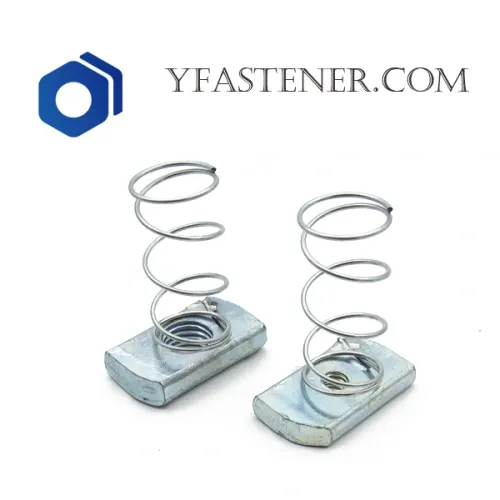
| Standard | DIN 3015, ISO 1391 |
| Size | M4, M5, M6, M8, M10 |
| Surface Treatment | ZP |
Product Introduction
Standard Designation: Spring Nut or Cage Nut.
Common Names: Cabinet Spring Nut, Server Nut, Sheet Metal Floating Nut.
Product Definition: A specialized fastener featuring an external cage frame constructed from spring steel plates, housing a floating square nut internally. Designed for square or rectangular mounting holes in sheet metal (e.g., cabinets, enclosures), it secures by compressing the spring plates into the hole. This provides a threaded connection point capable of front-to-back floating adjustment within a defined range, significantly facilitating equipment rail mounting and alignment.
Spring Nut ZP Key Features
Zinc Plated (ZP): Provides basic rust protection and a metallic sheen, enhancing corrosion resistance,
suitable for indoor or slightly damp environments.
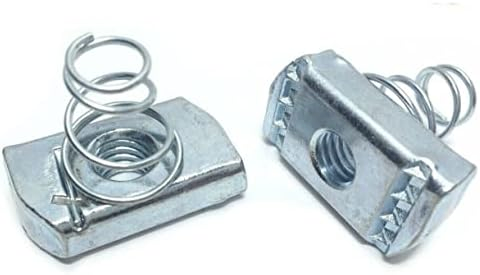
Spring Design: Built-in spring clips facilitate side insertion into the strut channel; the spring
automatically locks in place to prevent falling out.
Rectangular or Square Body: Fits standard struts (e.g., 41x41mm); anti-rotation edge design for quick
installation.
Material and Strength: Commonly made of carbon steel, medium strength; precision internal threads,
supports M6-M12 sizes.
Advantages: Single-sided installation, tool-free insertion, economical and practical; short or long
spring versions available.
Working Principle
Insertion into the Slot: Push sideways into the slot opening; the spring compresses and rebounds,
locking the slot edge and securing the position.
Threaded Fit: The internal thread matches the bolt; tightening the bolt generates axial clamping force.
Anti-rotation and load protection: The main body's edges are embedded with channels to prevent
rotation and evenly distribute pressure; the zinc plating provides corrosion protection.
Installation control: Springs ensure temporary fixation, facilitating single-person operation; the
principle involves elastic deformation and mechanical locking.
Product Applications
Electrical installation: Fixing cable trays, cable trays, or switch boxes; supporting pipe supports.
Mechanical equipment: Assembling frames, conveyor lines, or equipment supports for quick repositioning.
Building construction: Fixing interior ceilings, ducts, or ventilation systems.
Industrial plants: Installing warehouse shelves or lighting brackets; the zinc plating is suitable for
non-extreme environments.
DIY and maintenance: Modular assembly for convenience and reliability.