| Standard | DIN 553 |
| Grade | 8.8, 10.9 12.9 |
| Surface Treatment | ZP, BO |
Product Introduction
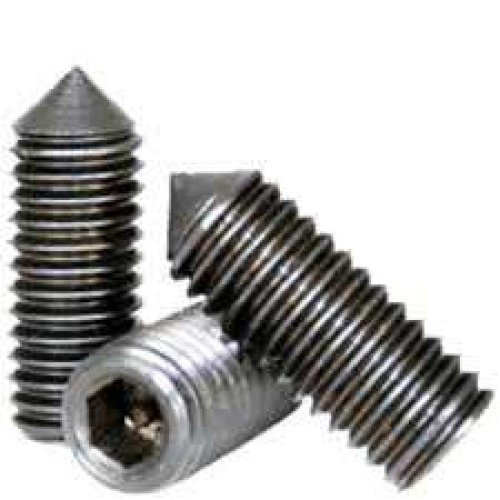
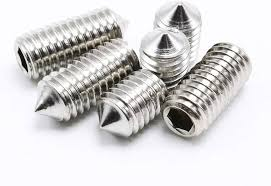
Standard Name: Cone Point Set Screw (Cone-End Set Screw / Top Screw)
Common Names: Cone-End Stop Screw, Cone-End Locating Screw, Pointed-End Machine Screw
Product Definition: A specialized fastener featuring a headless design, threaded shank, and conical tip. Its tapered point provides high-precision point-to-point contact, applying pressure or creating micro-indentations in material surfaces to achieve accurate radial positioning, prevent relative sliding between components, or adjust axial clearance.
Key Features of the Cone Point Screw
Tapered End Design: The end is sharply tapered (typically 45° or 60° angle), providing high concentrated
pressure, embedding into the surface of the fixed component, forming a secure position and
preventing slippage.
Headless Structure: Fully threaded and headless, using an Allen key for drive, concealed and
non-protruding after installation.
Materials and Coatings: Commonly used alloy steel, stainless steel, or carbon steel, with finishe
s including blackening, zinc plating (ZP), or a natural stainless steel luster, providing corrosion resistance.
Various Sizes: Diameters M3-M20, various lengths, conforming to standards such as DIN 914 and
ASME B18.3.
Advantages: Precise positioning, strong vibration resistance, concealed installation, but may damage
the fixed surface.
Working Principle
Insertion and Drive: The Allen key rotates the hexagonal socket, matching the thread with the internal
thread of the hole.
Preload Generation: When torque is applied, the screw advances, and the tapered point embeds into
the surface of the fixed component (such as a shaft or sleeve), forming a recess.
Positioning and Anti-Loosening: The concentrated pressure at the tapered point generates mechanical
locking, resisting axial slippage and vibration loosening; the principle involves material deformation
and frictional gripping.
Load Distribution: Primarily for shear force and positioning; not suitable for high tensile loads.
Product Applications
Mechanical Transmissions: Fixing pulleys, gears, or couplings on shafts to prevent axial movement.
Precision Instruments: Positioning machine tools, pumps, valves, or robot components for
high-precision anti-loosening.
Automotive and Motorcycles: Fixing handles, knobs, or drive shafts.
Electronic Equipment: Assembling motors or adjusting mechanisms for concealed installation.
Industrial Manufacturing: Universal positioning screws suitable for shaft and sleeve connections.