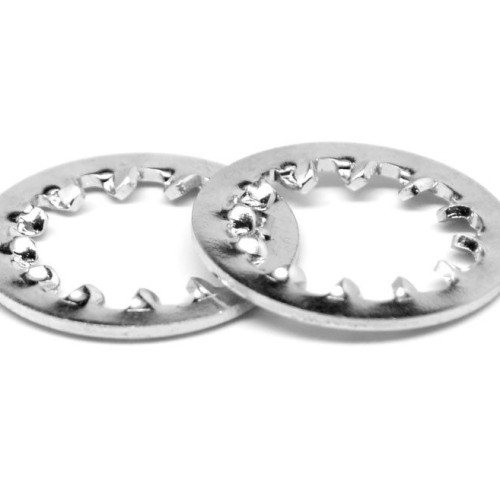
| Standard | ISO 2169, JIS B 1216 |
| Grade | A2-70 (304) , A4-80 (316) |
| Surface Treatment | ZP |
Product Introduction
Standard Name: Internal Tooth Lock Washer / Star Washer.
Common Names: Internal Tooth Star Lock Washer, Internal Tooth Spring Washer, Star Washer.
Product Definition: A locking washer featuring serrated teeth along its inner edge. During installation, the tooth tips bite into the surface of the nut (or bolt head) and the connected component, providing mechanical locking to prevent loosening caused by vibration or impact. This washer is designed for directional use.
Star Washer Internal Key Features
Internal Tooth Design: The inner ring features twisted teeth that engage with the nut/head and material
surface during compression, providing frictional locking and resisting loosening due to vibration.
Material and Coating: Commonly carbon steel with zinc plating (ZP) or other treatments for basic rust
protection; conforms to standards such as DIN 6797 J and ASME B18.21.1.
Ring Structure: A circular flat plate with inward-protruding internal teeth, suitable for use under the
bolt head, avoiding damage to visible surfaces.
Various Sizes: Inner diameter M3-M36, standard number of teeth and height, commonly used for electrical
or precision connections.
Advantages: Good anti-loosening effect, protects the surface, does not affect appearance, but the holding
force is not as strong as external teeth.
Working Principle
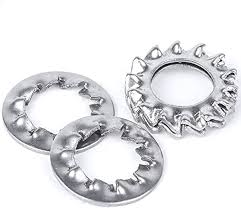
Compression Installation: Placed under the bolt head or nut, the teeth are compressed and deformed
during tightening.
Clamping Formation: The internal teeth engage with adjacent surfaces, generating friction and
mechanical locking to maintain the clamping force.
Vibration Resistance: Under vibration, the teeth prevent reverse rotation; the coating provides mild
corrosion protection.
Load Distribution: Evenly transmits pressure, preventing loosening; the principle involves elasti
deformation, tooth engagement, and frictional grip.
Product Applications
Electrical Connections: Secures grounding screws or terminals; internal teeth provide conductivity
and prevent loosening.
Electronic Equipment: Assembles panels or housings, preventing damage to coated surfaces.
Automotive and Instrumentation: Secures interior or precision components, resisting vibration.
Machinery Manufacturing: Machine tool or pump/valve connections, protecting visible surfaces.
Industrial Equipment: General-purpose anti-loosening fittings suitable for vibrating environments.