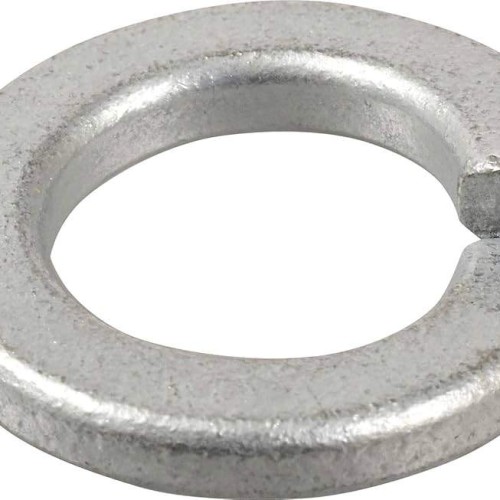
| Standard | DIN 127B |
| Surface Treatment | HDG |
Product Introduction
Standard Name: Spring Lock Washer (Hot-Dip Galvanized).
Common Names: Hot-Dip Galvanized Spring Washer, Hot-Dip Galvanized Lock Washer, HDG Spring Washer.
Product Definition: A single-coil spiral lock washer manufactured from spring steel with a hot-dip galvanized (HDG) surface treatment. It provides sustained preload through elastic deformation to prevent connection loosening, while its substantial hot-dip zinc coating delivers superior corrosion resistance far exceeding standard electroplating. Particularly suitable for outdoor, humid, or corrosive industrial environments.
Key Features of Spring Washer HDG
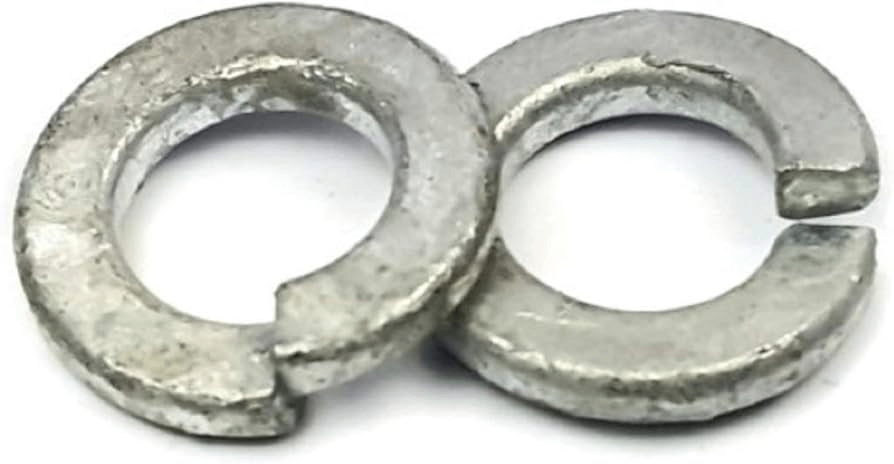
Hot-Dip Galvanized (HDG) Coating: Provides a thick zinc layer (typically 50-100μm), forming a
metallurgical bond, excellent corrosion resistance, suitable for outdoor or humid environments,
matte silver-gray surface, and a rough texture to enhance adhesion.
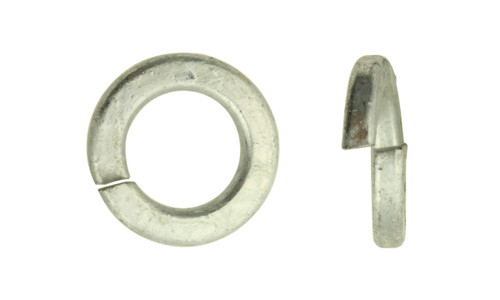
Split Spring Design: A ring-shaped split structure generates elastic restoring force upon compression,
providing continuous axial pressure and resisting vibration-induced loosening.
Materials and Strength: Commonly used carbon steel or alloy steel, high elasticity; conforms to standards
such as DIN 127 and ASME B18.21.1.
Various specifications: Inner diameter M3-M48 (or #4-2"), standard thickness, commonly used for
bolt/nut fittings.
Advantages: Reliable anti-loosening, strong weather resistance, economical and durable, suitable for
harsh conditions.
Working Principle
Compression Installation: Placed under the nut, the washer is compressed upon tightening, causing
elastic deformation at the split end.
Restoring Force Generation: The elastic restoring force provides continuous spring force, maintaining
the clamping force.
Vibration Resistance: Under vibration, the restoring force prevents the nut from rotating backward;
the zinc layer acts as a sacrificial anode, preferentially oxidizing and protecting the substrate.
Load Distribution: Evenly transmits pressure, preventing loosening; the principle involves elastic
deformation, frictional grip, and electrochemical protection.
Product Applications
Steel Structure Engineering: Secures beams and columns of bridges, factories, or high-rise buildings,
resisting vibration and atmospheric corrosion.
Infrastructure: Used for power towers, highway guardrails, or pipeline systems, providing long-term
anti-loosening.
Marine and Outdoor: Connects dock equipment or fencing, resistant to salt spray and moisture.
Industrial Equipment: Assembles heavy machinery or warehouse structures, economically suitable for
harsh conditions.
Energy Sector: Wind turbine towers or solar panels, ensuring stability.