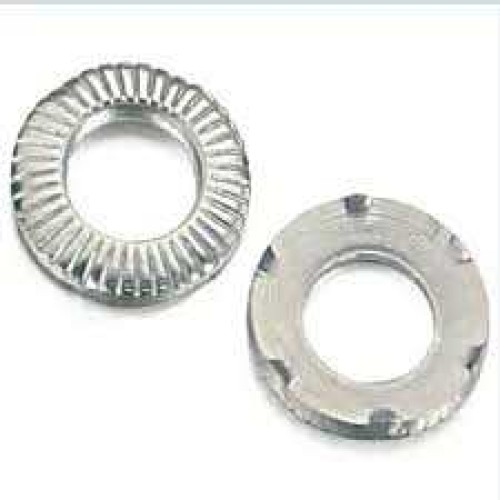
| Standard | DIN 6795 |
| Grade | M6, M8 |
| Surface Treatment | Passivated |
Product Introduction
Standard Name: Contact Washer / Bonding Washer.
Common Names: Contact Washer, Conductive Washer, Grounding Washer, Potential Equalization Washer.
Product Definition: A specialized washer designed to establish stable and reliable electrical connections between metal components. Typically manufactured from highly conductive materials or featuring unique surface structures such as serrations or star patterns to pierce through metal surface oxides or coatings, ensuring low-resistance contact. Used in grounding, static dissipation, electromagnetic shielding, and similar applications.
Contact Washer Key Features
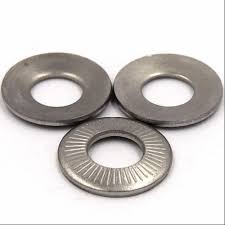
Conical Design: Conical shape generates elastic force during installation, evenly distributing pressure
and compensating for gaps.
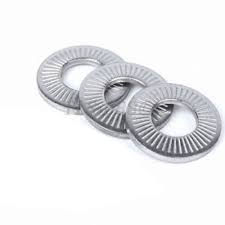
Needle or Knurled Surface: One side has a knurled ring or teeth to enhance anti-loosening and
engagement, preventing bolt rotation; the other side is smooth or toothed for electrical contact.
Materials and Coatings: Commonly used spring steel or stainless steel, with zinc plating or special
treatments for corrosion resistance.
Various Sizes: Compliant with NFE 25-511 or Siemens SN 70093 standards, sizes M3-M16.
Advantages: Anti-loosening, vibration-resistant, gap-compensating, suitable for electrical connections
(piercing coating ensures contact).
Working Principle
Compression Installation: Placed under the bolt head or nut, the conical deformation generates elastic
restoring force upon tightening.
Anti-loosening and Compensation: Knurled/toothed embedded surfaces prevent rotation; elastic force
maintains clamping force, compensating for gaps caused by thermal expansion and contraction
or vibration.
Electrical Contact: Toothed piercing of coatings or oxide layers ensures low-resistance connections.
Load Distribution: Tapered, uniform pressure transmission avoids localized stress; the principle involves
elastic deformation, frictional grip, and mechanical locking.
Product Applications
Electrical Connections: Secure grounding, terminals, or coated surfaces to ensure stable conductivity.
Mechanical Manufacturing: Vibration damping for bolted connections, such as in engines, gearboxes,
or equipment components.
Automotive and Industrial: Assembling vibrating components and compensating for gaps.
Construction Engineering: Secure steel structures or piping, providing long-term stability.
Precision Equipment: Suitable for high-strength bolts (8.8-10.9 grade) for enhanced safety.