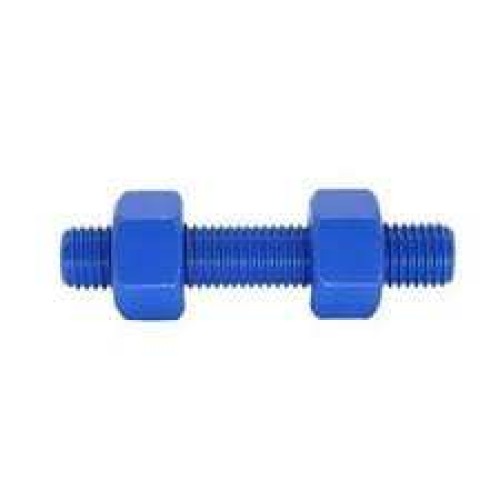
| Standard | DIN 975 |
| Grade | 4.8, 8.8 |
| Surface Treatment | PTFE |
Product Introduction
Standard Name: PTFE Coated Stud Bolt or Teflon-Coated Double-Ended Stud.
Common Names: Teflon stud, PTFE-coated double-ended stud, anti-adhesion corrosion-resistant stud.
Product Definition: A rod-shaped fastener with threads at both ends, featuring an integral coating of Teflon (polytetrafluoroethylene, PTFE). This coating endows the bolt with exceptional chemical inertness, an extremely low coefficient of friction, outstanding anti-adhesion properties, and broad temperature resistance. It serves as a specialized solution for high-cleanliness and highly corrosive environments in chemical, food processing, pharmaceutical, and similar industries.
New Teflon-Coated Double-Ended Stud Bolts Key Features
Teflon (PTFE) Coating: Typically 15-30μm thick, providing extremely low friction coefficient (0.05-0.10),
excellent non-stick properties, chemical resistance (acids, alkalis, solvents), and self-lubricating
performance. Commonly available in blue or green coating for easy identification.
Double-Ended Thread Design: Equal or unequal length machine threads at both ends (headless), with a
smooth shank or full thread in the middle, facilitating connection to flanges or components with nuts.
Material and Strength: Base material commonly uses high-strength alloy steel (such as ASTM A193 B7,
B8, B8M or A320 L7), with strength grades 8.8-12.9, and high-temperature resistance (-200°C to +260°C).
Diverse Specifications: Diameters M6-M100 (1/4"-4"), lengths 50-1000mm, often paired with A194
heavy-duty nuts.
Advantages: Anti-sticking, corrosion resistance, easy disassembly, reduced torque requirements,
extended service life, especially suitable for frequent assembly and disassembly applications.
Working Principle
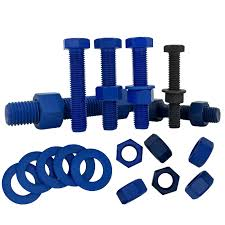
Coating Lubrication: The PTFE coating significantly reduces the thread friction coefficient, reducing the
required torque during installation by 30-50%, resulting in more uniform preload.
Thread Fastening: Nuts are tightened at both ends, generating axial clamping force to secure flanges
or components.
Corrosion Protection: The coating isolates the base material from corrosive media, preventing
electrochemical corrosion and galling.
Anti-Stick Disassembly: The non-stick properties ensure that multiple assemblies and disassemblies
do not damage the threads; the principle involves low friction, self-lubrication, and chemical inertness.
Product Applications
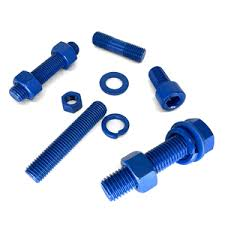
Petrochemical Industry: Flange connections for pipes, valves, and pressure vessels, providing corrosion
resistance and easy maintenance.
Offshore Platforms: Securing offshore equipment, resisting salt spray and seawater corrosion.
Food and Pharmaceutical Industries: Sanitary pipeline connections, non-stick properties prevent
contamination.
Power and Energy: High-temperature, high-pressure flanges (such as those in boilers and steam pipes),
reducing the risk of seizing.
General Industry: Any bolted connection requiring corrosion resistance, low friction, and repeatable
disassembly and reassembly.