| Standard | GB /T 22795 |
| Grade | A2-70 (304) , A4-80 (316) |
| Surface Treatment | PL |
Product Introduction
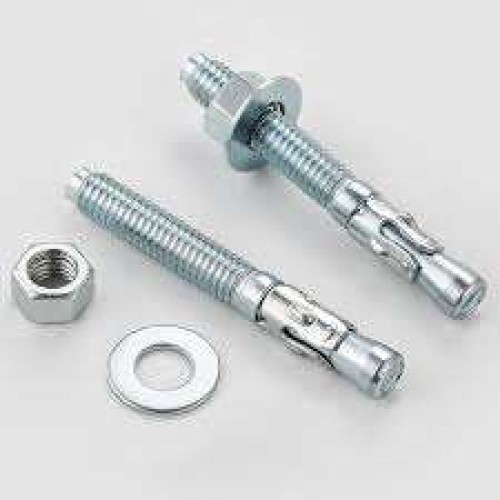
Standard Name: Stainless Steel Wedge Anchor.
Common Names: Stainless Steel Wedge Anchor Bolt, Stainless Steel Expansion Bolt, SS304/SS316 High-Strength Wedge Anchor.
Product Definition: A post-installed mechanical expansion anchor made of stainless steel. Its principle involves inserting a bolt with a tapered tail end into a pre-drilled hole. Tightening the nut causes the tapered section to expand the sleeve at the anchor's tail, generating significant friction and mechanical interlocking within the concrete hole walls. This achieves high-load-bearing fixation. It is renowned for its high strength and excellent corrosion resistance.
Wedge Anchor SS Key Features
Stainless Steel (SS): Commonly AISI 304 or 316 grade, providing excellent corrosion resistance, oxidation
resistance, and hygienic properties, suitable for humid, acidic, alkaline, or salt spray environments.
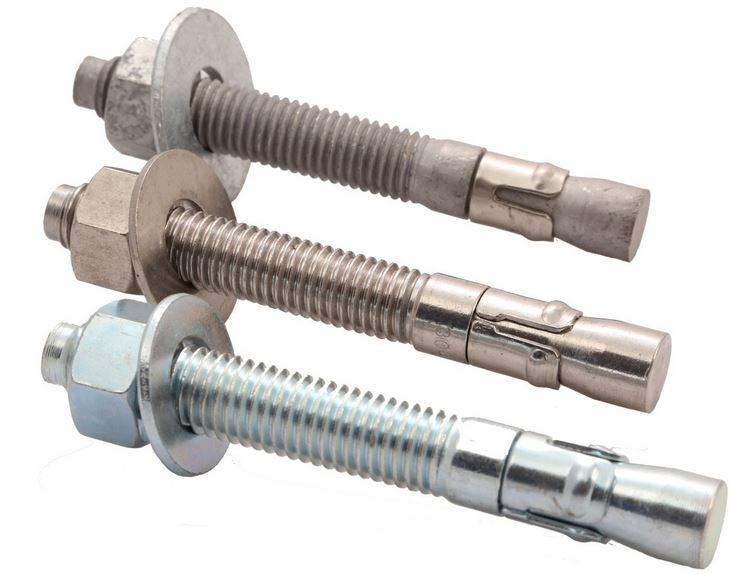
Wedge Expansion Design: The tapered wedge and clamp at the bottom expand outward when tightened,
gripping the concrete tightly and providing extremely high holding power and shock resistance.
Head Type: Typically hexagonal head for easy torque installation; comes with washers and nuts.
Various Sizes: Diameter M6-M24 (1/4"-1"), length 50-300mm, conforming to ASTM F593 or similar
standards.
Advantages: Extremely strong holding power, vibration resistance, removable, durable, and hygienic,
but requires precise drilling and torque control.
Working Principle
Drilling Installation: Drill a hole of the matching diameter and depth in the concrete and insert the anchor.
Expansion Process: When tightening the nut, the conical wedge pulls into the clamping plate, which
expands outward to grip the hole wall.
Load Distribution: The expansion force is evenly distributed, providing high pull-out and shear strength;
the stainless steel passivation layer resists corrosion.
Fixing and Removal: A strong clamping force is generated, allowing the nut to be loosened and removed;
the principle involves mechanical wedge expansion and frictional gripping.
Product Applications
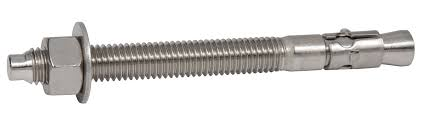
Civil Engineering: Fixing steel beams, railings, or curtain walls to concrete, providing structural stability.
Marine and Shipbuilding: Installing equipment or structures to resist seawater corrosion.
Chemical and Food Industries: Fastening pipes or processing equipment, hygienic and resistant to acids
and alkalis.
Infrastructure: Bridge railings or outdoor fixing, long-term weather resistance.
Industrial Equipment: Assembling heavy machinery bases or supports, ensuring vibration resistance and
safety.