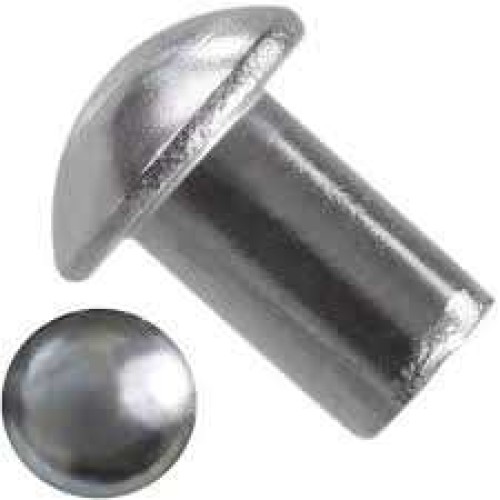
| Standard | GB/T 863.1-1986, DIN 660 |
| Surface Treatment | ZP, BO |
Product Introduction
Standard Name: Round Head Rivet / Half-round Head Rivet.
Common Names: Round Head Rivet, Half-round Head Rivet, Solid Rivet.
Product Definition: A solid rod-shaped mechanical fastener with one end preformed into a round head. By hammering or pressing the other end (tail end) into an installation hole to deform it into another head (flange), it permanently connects two or more components. Its round head design enables it to withstand significant lateral loads.
Round Head Rivet Key Features
Round Head Design: The head is hemispherical (dome head), providing a larger bearing surface and an
aesthetically pleasing appearance, suitable for visible surfaces or applications requiring even pressure
distribution.
Diverse Materials: Commonly made of aluminum alloy, steel, copper, stainless steel, or brass, offering
varying strength, corrosion resistance, and conductivity; aluminum is lightweight and corrosion-resistant,
while steel offers high strength.
Solid Structure: The rivet body is completely solid, without a core pin, forming a permanent connection
through riveting deformation after installation.
Diverse Specifications: Available in diameters of 3-20mm and lengths of 5-100mm, conforming to
standards such as DIN 660 and ISO 1051.
Advantages: High connection strength, vibration resistance, durability, and cost-effectiveness, but
requires a riveting gun for installation and is not removable.
Working Principle
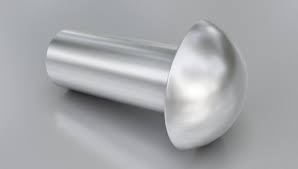
Drilling and Insertion: Drill a matching hole in the material, insert the rivet into the hole, with the head
flush against the surface.
Riveting Deformation: Use a riveting gun or hammer to deform the tail end, causing it to swell and expand,
forming a second head (shop head).
Permanent Fixing: After deformation, the two heads clamp the material, providing high pull-out and
shear strength.
Load Distribution: The round head evenly distributes pressure; the principle involves material plastic
deformation and frictional gripping.
Product Applications
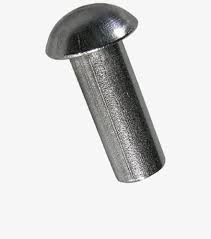
Aerospace and Automotive: Fixing aircraft fuselages, car body panels, or structural components,
providing high strength and reliability.
Construction Engineering: Connecting steel beams, roof panels, or bridge components, offering durability
and vibration resistance.
Mechanical Manufacturing: Assembling equipment housings or frames; the round head is aesthetically
pleasing and suitable for visible surfaces.
Marine and Electrical Appliances: Aluminum/copper rivets are used for corrosion resistance or conductive
connections.
General Fastening: Permanent riveting in furniture, luggage, or DIY projects.