| Grade | A2-70 (304) , A4-80 (316) |
| Surface Treatment | ZP, PL, HDG |
Product Introduction
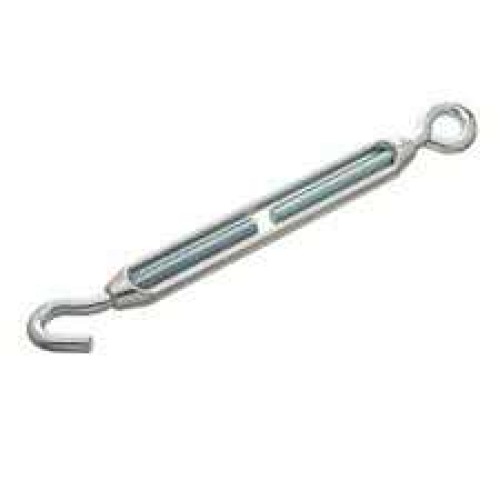
Standard Name: Turnbuckle.
Common Names: Flower basket screw, tensioner, expander, line tensioner.
Product Definition: An adjustable connecting device used for tensioning, adjusting, or connecting ropes, steel cables, chains, or cables. Typically composed of a metal body with left- and right-hand threads at both ends (usually an eye ring, hook ring, or J-hook) and a central connecting body. Precise adjustment of overall length and tension is achieved by rotating the connecting body.
Turnbuckle Key Features
Double-ended threaded design: Threads in opposite directions at both ends (one left-hand, one
right-hand), with a rotating handle or hexagon in the middle body for easy length and tension adjustment.
Frame types: Common types include eye & eye, hook & hook, jaw & jaw, or mixed types, offering different
connection methods.
Material and coating: Commonly made of carbon steel with zinc plating (ZP), hot-dip galvanized (HDG),
or stainless steel (SS), providing different levels of corrosion resistance; high-strength types comply with
DIN 1480 or EN 13889 standards.
Diverse specifications: Diameters from M6-M48 (1/4"-2"), lengths from 100-600mm, and load capacities
from hundreds of kilograms to tens of tons.
Advantages: Adjustable tension, easy installation, reusable, economical and durable, especially suitable
for tensioning wire ropes or rods.
Working Principle
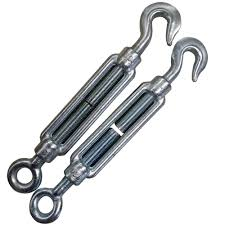
Connection and installation: Connects to wire ropes, chains, or rods at both ends (via eyes, hooks, or jaws).
Rotation adjustment: When the middle frame is rotated, the opposite threads simultaneously pull or push
the ends closer or further apart, adjusting the total length and tension.
Pre-tensioning: Generates axial tension force, evenly distributed to the connecting parts.
Locking and anti-loosening: Often equipped with locking nuts or pins to prevent reverse rotation; the
principle involves differential threads and frictional interlocking.
Product Applications
Construction engineering: Tensioning wire ropes, suspension rods, or curtain wall supports, providing
structural stability.
Marine and offshore: Securing sails, anchor chains, or deck equipment; stainless steel versions are salt
spray resistant.
Lifting and hoisting: Adjusting the length of slings or chains to ensure load balance.
Stage and lighting: Suspending lighting fixtures, sound equipment, or stage sets, allowing for precise
height adjustment.
General tensioning: Fences, greenhouses, bridges, or antenna fixing, providing an economical and
reliable solution.